
Vircator vs Reltron
What’s the difference?


Do your neighbors have a Reltron in their garage? Does it look “handheld”? A weapon similar to this was likely used in Venezuela to disable the guards in seconds. It is mounted on a satellite and precisely controlled from Schriever Base, using GPS coordinates.
/
Fisica, Inc acquired the division of L3Harris that makes the Vircator/Reltron. The company is located at 2700 Merced St, San Leandro, California.
https://www.fisica.com/ati
The ATI Division of the new company openly admits they still manufacture and sell Reltrons. This is their trademark name for a Vircator with efficiency improvements.
“In the field of high-power microwaves, we produce tunable, narrowband Reltrons™ and magnetron and ultra-wideband (UWB) short-pulse sources.”
/
How much electricity is needed?

/
/
So what’s the difference?
Reltron and Vircator (short for Virtual Cathode Oscillator) are both specialized high-power microwave (HPM) sources, typically driven by intense relativistic electron beams in pulsed power systems. They generate very high peak microwave powers (often hundreds of MW to multi-GW levels) in short pulses, with applications in directed energy research, radar, and potential defense-related uses.
Here’s a breakdown of the key differences:
Operating Principle
Vircator: Relies on the spontaneous formation of a virtual cathode (a region of space charge that reflects electrons back toward the real cathode). When an intense electron beam current exceeds the space-charge limiting current in a diode (typically a reflex triode, axial, or coaxial geometry), electrons bunch and oscillate between the real and virtual cathodes. This oscillation directly produces broadband or tunable microwaves without requiring external resonant cavities for frequency control in the basic design.
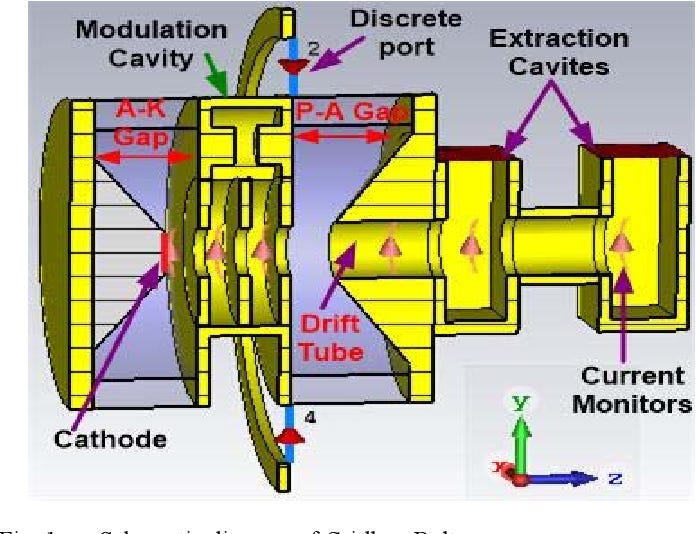
Reltron (or Super-Reltron): A more structured, klystron-like device. It uses a side-coupled modulation cavity(often with grids or gridless variants) to strongly pre-modulate or bunch the electron beam at the input. The well-bunched beam is then post-accelerated and interacts with one or more output extraction cavities to efficiently convert beam kinetic energy into microwave energy. It behaves like an advanced relativistic klystron amplifier/oscillator with built-in strong pre-bunching.
Efficiency
Vircator: Generally low to moderate efficiency (classically ~1–10%, with optimized or modified designs reaching 20–30% in some experiments, e.g., with reflectors or multiple virtual cathodes).
Reltron: Significantly higher efficiency (typically 40–50%, with reports of >400 MW at ~50% efficiency in early super-reltron demonstrations; modern variants aim even higher).
Bandwidth / Frequency Control / Purity
Vircator: Often broadband or widely tunable (frequency depends on beam voltage, current, and geometry), but output tends to be less coherent and mode-pure (mixed modes like TM₀₁ + others common).
Reltron: Narrower bandwidth, better frequency stability and mode purity due to resonant cavities (operates at well-defined cavity resonances, with variants supporting harmonic extraction, e.g., 1 GHz fundamental → 3 GHz output).
Complexity / Design
Vircator: Extremely simple mechanically — basically a diode (cathode-anode-drift region), no magnetic field required in many configurations, very few parts, low cost, and compact.
Reltron: More complex — includes modulation cavity (often with grids), post-acceleration region, and multiple output cavities. This added structure enables the high efficiency but increases fabrication and tuning requirements.
Power / Pulse Characteristics
Both can reach GW-class peak powers in short pulses (tens to hundreds of ns), but:
Vircators are often favored for ultra-simple, very high peak power demonstrations.
Reltrons excel in higher energy per pulse and better repetitive-rate potential (some designs tested at 20 Hz with long pulses).
In short:
A vircator is a simple, rugged, but relatively inefficient HPM source that generates microwaves directly from virtual cathode oscillations.
A reltron is a more sophisticated, highly efficient HPM oscillator that uses cavity-based beam pre-modulation and extraction, similar to a relativistic klystron, to achieve much better power conversion from the electron beam.
https://www.researchgate.net/figure/Supra-HPM-generator-PFN-Marx-Reltrons-and-waveguides-system-lowered-in-pit_fig7_3056683
https://www.researchgate.net/figure/D-schematic-diagram-of-a-reltron_fig2_308669404
/
*Targeted Justice is a 501c(3) nonprofit. We are a news media representative as defined by Federal law.
/

In the top picture of the Reltrons being tested, after final assembly - what are the dimensions of the overhead waveguide? I estimate 2 inch by 4 inch.
WR-430 waveguide is 2.15 x 4.3 inch. Frequency range is 1.7 GHz to 2.6 GHz.
Did you notice this range includes 2.45 GHz - same frequency used for microwave ovens?
What causes nausea and vomiting - they are cooking your stomach like a microwave oven. It also causes the small blood vessels in your nose to burst. Coincidence?
Now we know what happened in Venezuela…
You’re welcome.
Microwave beam weapon likely used in Trump USA attack of Venezuela Maduro
Reports from Venezuela troops military police security forces report symptoms such as
Vertigo dizziness extreme pain disorientation inability to address defend attack or repel incoming military forces whereby
300 US military forces were able to attack kill disorient and or defeat
Thousands of Venezuelan military police and security forces
While sustaining zero USA casualties or losses
I'll take what is asymmetric warfare for $1000 Alex