

Grok: How can we shut down the Deep State?
Grok replied with 6 key points:
These are high-level strategies drawn from critics, historians, and policymakers, emphasizing systemic change through elections, legislation, and activism rather than any direct confrontation. Here’s a summary of commonly suggested methods:
1. Campaign Finance Reform
Reducing the flow of corporate and lobbyist money into politics is seen as foundational, as it diminishes the MIC’s ability to sway lawmakers through donations and revolving-door jobs. This could involve laws to limit contributions, abolish corporate personhood, or enforce stricter anti-trust regulations on defense contractors.
2. Downsizing and Redeploying Military and Intelligence Resources
Advocates propose cutting military budgets, ending perpetual wars, and reallocating funds to domestic needs like infrastructure. This includes exercising stronger civilian oversight of the Pentagon via Congress, reducing the size of intelligence agencies, and limiting foreign arms sales that fuel conflicts. Sensible redeployment might involve closing unnecessary bases or shifting focus from global primacy to defense-only postures.
3. Reforming Federal Bureaucracy and Agencies
Proposals include reducing the federal workforce, stripping job protections from certain civil servants to allow easier removal of entrenched officials, and reforming agencies like the DOJ and FBI to root out perceived corruption. This could involve executive orders to reclassify positions, move operations out of Washington, D.C., and prioritize political appointees over career bureaucrats.
4. Implementing Term Limits and Anti-Corruption Measures
Enforcing term limits for Congress and officials to prevent long-term entrenchment, alongside creating oversight bodies like truth and reconciliation commissions to investigate abuses. Strengthening anti-corruption laws, such as expanding the Foreign Corrupt Practices Act, could target defense industry influence.
5. Building Grassroots Movements and Class-Based Politics
Reviving labor unions, populist coalitions, and social movements (drawing from historical examples like the New Deal era, civil rights struggles, or Occupy Wall Street) to foster class solidarity and challenge elite power. This involves supporting progressive candidates who prioritize anti-war policies and economic democracy.
6. Promoting Transparency and Media Reform
Addressing media concentration to ensure better coverage of MIC spending and influence, while establishing monitoring systems for intelligence agencies. Public education on these issues through advocacy could build support for reforms. These approaches are debated in sources like political interviews, think tank reports, and policy agendas, often tied to figures like Eisenhower’s warnings or modern critics. Success would require broad electoral support and sustained pressure, as entrenched systems resist change.
\
\
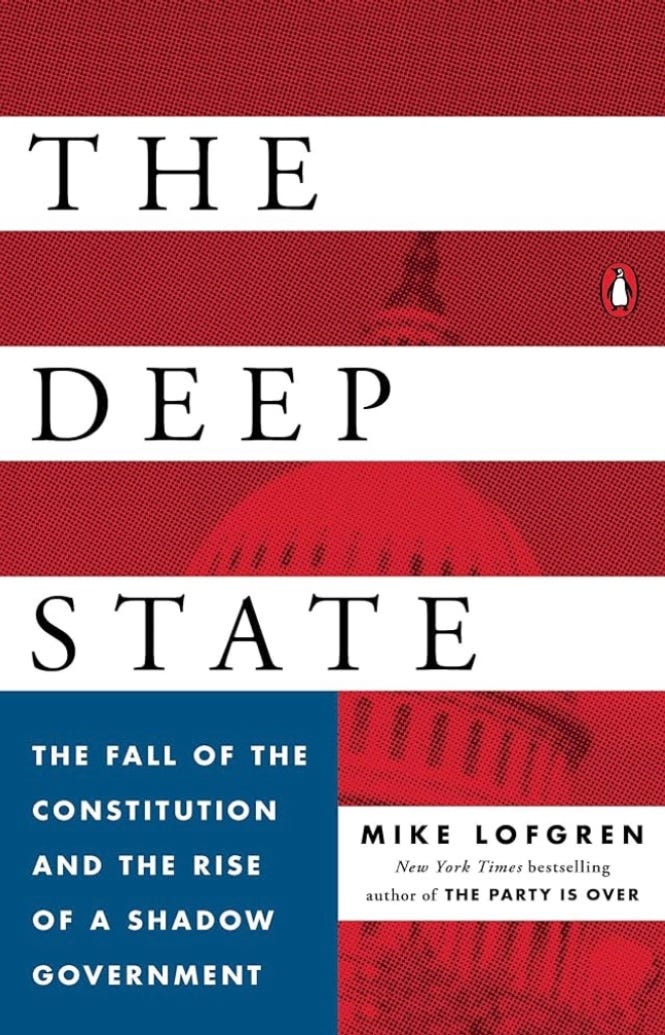
Mike Lofgren’s 2016 book
The Deep State: The Fall of the Constitution and the Rise of a Shadow Government
This book draws on his 28 years as a congressional staffer (primarily as a Republican national defense analyst on the House and Senate Budget Committees) to argue that true power in the U.S. resides not with elected officials but with an unelected, entrenched network of bureaucrats, corporate interests, national security agencies, and private contractors. He describes this “Deep State” as a hybrid entity—a “de facto oligarchy” operating above the law and camouflaged by the outward form of constitutional government—that influences policy with limited regard for public consent or democratic accountability. Lofgren portrays it as the “red thread” connecting major issues like perpetual wars, economic financialization, rising plutocracy, and political dysfunction, eroding the Constitution through a “revolution within the form.”
Core Definition and Components
Lofgren defines the Deep State as an interconnected web including:
National security and intelligence agencies (e.g., NSA, CIA), which he criticizes for overreach, incoherence (like arming groups in one region while bombing them in another), and militarization of foreign policy.
Wall Street and big banks, accused of waging “economic warfare” through bailouts, deregulation, and influence that prioritizes profits over public welfare.
Silicon Valley tech giants, integrated via surveillance contracts and data-sharing that bolster the surveillance state.
Beltway insiders (lobbyists, contractors, think tanks, and media), who thrive in “Beltwayland”—Washington, D.C., as a garrison-like imperial hub hooked on war, austerity hypocrisy, and discredited ideologies.
He contends this system renders elections largely irrelevant, as personnel and policy continuity persist regardless of party changes, while public institutions serve as fig leaves for private gain. Examples include post-9/11 expansions, the Citizens United decision enabling plutocracy, unchecked torture programs, and mortgage fraud without prosecutions.
Lofgren emphasizes that the Deep State operates “in plain sight,” banal yet insidious, and calls for systemic reforms to restore accountability.
Here’s a summary of his 9-point plan to shutdown the Deep State:
Eliminate private money from public elections: Implement campaign finance reforms to remove corporate and wealthy donor influence, ensuring politicians serve voters rather than special interests.
Sensibly redeploy and downsize the military and intelligence complex: Reduce the oversized national security apparatus, for example by withdrawing from bases like those in South Korea, to curb wasteful spending and overreach.
Stay out of the Middle East: End interventionist policies and perpetual engagements in the region to avoid endless wars and focus on domestic priorities.
Redirect the peace dividend to domestic infrastructure improvement: Reallocate savings from military cuts to rebuild U.S. roads, bridges, and other public works.
Start enforcing antitrust laws again: Break up monopolies and regulate big corporations to promote competition and prevent economic concentration of power.
Reform tax policy: Revise the tax code to make it fairer, closing loopholes for the wealthy and corporations while ensuring progressive taxation.
Reform immigration policy: Create a balanced system that addresses root causes like U.S. foreign policy impacts, while rejecting exploitative practices like unlimited H-1B visas that undercut workers.
Adopt a single-payer health care system: Establish universal, government-run health care to reduce costs, improve access, and eliminate profit-driven inefficiencies.
Abolish corporations’ personhood status, or else treat them exactly like persons: End the legal fiction of corporate personhood (e.g., from Citizens United) or apply full personal liabilities and responsibilities to corporations.
\
What are your thoughts? Post comments below.
\

Start with reversing Citizens United, term limits for Supreme Court Justices, and then hang all the corrupt law enforcement types and those who have participated in targeting fellow countrymen and those around the world with DEWs and psychological warfare.
Nice points, but ...
without subjecting AIPAC to FARA and abolishing the ADL, no way this could ever happen ...